Showing posts with label Corsairs. Show all posts

Saturday, June 14, 2008

Privateer, Corsair or Buccaneer?

Often when people talk about pirates, they'll use the following words interchangeably: Privateer, Corsair, Buccaneer, and Pirate. But in truth, they refer to different things. This primer should help clear up misconceptions.

Pirate: [pahy-ruht] noun
1.a person who robs or commits illegal violence at sea or on the shores of the sea.
2.a ship used by such persons.
3.any plunderer, predator, etc.: confidence men, slumlords, and other pirates.
4.a person who uses or reproduces the work or invention of another without authorization.
5.Also called pirate stream. Geology. a stream that diverts into its own flow the headwaters of another stream, river, etc.
Pirate basically is the vague term that refers to all these sea-criminals. It's hard to mis-use, and applies to all sorts of people and activities.

Privateer: [prahy-vuh-teer] noun
1. an armed ship that is privately owned and manned, commissioned by a government to fight or harass enemy ships.

All privateers are pirates, but not all pirates are privateers. Privateers carry letters of marque from a government, basically a get out of jail free card that can be cashed at their ports when that pirate raids ships belonging to their enemies. Many pirates collected several different country's letters of marque, but one man's legitimate businessman or patriotic hero, is another man's pirate and rogue, and when one's allegiances are constantly changing its a recipe for trouble. But on the high seas, trouble is a pirate's middle name.

Buccaneer: [buhk-uh-neer]
1.any of the piratical adventurers who raided Spanish colonies and ships along the American coast in the second half of the 17th century.

When most people think of pirates, they're thinking of buccaneers. Pirates of the Caribbean who raided the Spanish Main, who elected their captains and made names for themselves in the new world. The romantic image of piracy grew out of these rogues, fiercely democratic, often cruel, swashbuckling and prone to burying treasure (ok, prone to spending treasure as soon as they could get to a port). Buccaneers are also called Freebooters, from the dutch term for the pirates that operated in the Caribbean during the period.

The word Buccaneer comes from the french boucanier, which referred to men who hunted and smoked meat alone in the wilderness. These men were common on Hispaniola and other islands where they were often picked up by ships, and traded their wares and fearsome skills at butchery.
Corsair: [kawr-sair] noun
1.a fast ship used for piracy.
2.a pirate, esp. formerly of the Barbary Coast.

Corsairs, also referred to as Barbary Corsairs came from North Africa and ranged as far afield as India and Ireland. They were subject to the sultanates of their home ports but often had a say in their own governance, even before Europe was toying with democracy. Check out this Bicameral Legislature. They often took slaves as part of their crews, but slaves got six months of the year off and often converted to Islam and rose to own their own ships. Upward mobility of this sort was unheard of in Europe and a huge number of single men without other prospects emigrated from Europe to convert to Islam and seek their fortunes.

Thursday, April 17, 2008

James Madison, Hater of Pirates

James Madison, Fourth President of the United States of America would be 257 this year and his positions on foreign policy are seminal in the United States early diplomatic history and the United States first interactions with the Muslim World.

Madison, serving as secretary of state under President Jefferson, advocated waging war against the brutes. In 1801, the U.S. refused to hand over any more money, and battles ensued, according to the Montpelier Foundation, whose mission is to preserve Madison’s legacy. By 1805, the Marines had successfully defeated the pirates and the payoffs ceased.

European nations had entered into treaties with the Barbary States whereby they were at peace, but the European nations paid a yearly tribute to ensure the safe release of any hostages taken. The United States chose to not pay, and sent the first marines to battle the corsairs into submission and to release their hostages in the First Barbary War. In the end, the United States won handily and came to a treaty with the Bashaw of Tripoli that ended the war in exchange for ransoming the hostages. The treaty was a questionable triumph for the Jefferson administration and after the war of 1812 a Second Barbary War that included a coalition of European forces along with the US changed the acceptability of the Corsairs in the Mediterranean.

James Madison's is considered the loudest hawkish voice in Jefferson's cabinet that pushed the young country into this battle. His position eventually led to the downfall of the Corsair empires of North Africa.
Today, "the shores of Tripoli" are immortalized in the U.S. Marine Corps's anthem and in monuments such as the Tripoli Monument at the U.S. Naval Academy in Annapolis, Maryland.

Friday, December 7, 2007

What Have Pirates Done For Me Lately? -Bicameral Legislature


The Pirate Utopia of Salé on the Moroccan coast was a truly independent state for decades in the 16th century. While the rest of North Africa was being carved up among the Ottomans and various Sufi princes, democracy of a kind was flourishing.

Salé was ruled by the Taiffe Reisi or Council of Captains and the Divan, which was populated by former commander-in-chiefs. Becoming a voting member of the legislature was as simple as staying alive long enough to rise through the ranks of corsairs. Every two months a new commander-in-chief, "Agha of Two Moons," took over as head of the corsair fleet. This gave an unprecedented level of opportunity to men who took up the vocation of corsair. A man, regardless of birth, could rise to the highest levels of government.

This form of government was the first democratic government after Greece and heavily influenced European Democracies that would follow it.


Modern Salé and Rabat

Friday, November 30, 2007

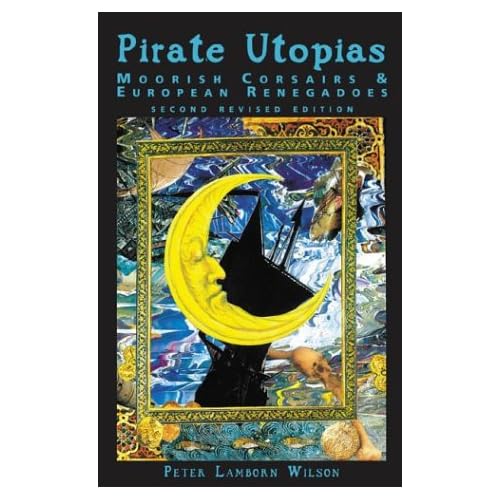
Book Review: Pirate Utopias


Pirate Utopias: Moorish Corsairs and European Renegadoes
by Peter Lamborn Wilson


I simply cannot get enough of this book. Wilson is a renowned resource on Sufism and the Muslim World and in this tome he takes a stab at Barbary Corsairs, Early Democracy and the interplay between Islam and Christianity in 11th century Europe.

An excellent entry point into the concept of Temporary Autonomous Zones, Wilson finds ways to incorporate the beauty and majesty of Islamic poetry and the sensuous feeling of Moroccan culture and the excitement of the freedom and cacophony of the Barbary Capitals: Libertalia, Tunis, Algiers, Salee.

A few years ago I was able to see Peter Lamborn Wilson speak at a party for a New York City Secession Movement. His charming style and command of his subject matter kept the audience rapt and I found this book to have a similar highly entertaining, often funny voice. A non-fiction book that you can't put down is a rare bird indeed and I felt as soon as I'd opened it I was transported to a time of possibility and hardship, when men were carving political power out of raw chaos and a new religion was drawing the dregs of Europe and forging the basis for modern governments.

Five out of Five Hooks
______________________________________________

An Essential Part of any Pirate Library